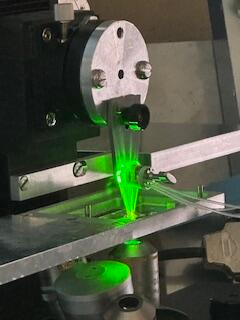
Mission
Develop microfluidic probe heads capable of delivering and aspirating microvolumes of reagents near targeted biological surfaces.
Research Context
Localized reagent delivery enables researchers to study cellular responses while minimizing reagent consumption and improving spatial control.
Approach
Designed PDMS probe heads containing integrated injection and aspiration microchannels capable of creating localized flow regions near the target substrate.
Fabrication Process
Fabricated PDMS devices using soft-lithography workflows and assembled probe heads containing microchannel networks for fluid delivery and removal.
Validation
Used optical microscopy and fluorescence imaging to verify channel integrity, detect blockages, and confirm successful fluid transport through the microchannel network.
Outcome
Produced functional microfluidic probe head prototypes and gained experience in device fabrication, microscopy inspection, and microfluidic validation workflows.
Microfluidic Probe Concept
A microfluidic probe acts like a tiny "liquid pen" that can deliver a small amount of reagent to a specific area on a surface without flooding the entire sample.
The probe has small channels that inject liquid onto the target area and then pull the liquid back up through nearby aspiration channels. This creates a confined treatment zone, allowing researchers to expose only selected cells or regions to a reagent while observing the response under a microscope.
Figure adapted from Delamarche et al., "Hydrodynamic Flow Confinement Using a Microfluidic Probe," in Open-Space Microfluidics, Wiley-VCH, 2018.
System Components
A microfluidic probe system is not just the small PDMS probe head. It also needs supporting hardware to position the probe, move it over the sample, and control the flow of liquid.
The probe head is connected to pumps, tubing, and control valves that deliver and remove fluid. It is mounted on microscope positioning stages so researchers can precisely align the probe over a target area and scan across a sample while observing the process under a fluorescence microscope.
Figure adapted from Delamarche et al., "Hydrodynamic Flow Confinement Using a Microfluidic Probe," in Open-Space Microfluidics, Wiley-VCH, 2018.
Application in the Lab