Problem
Commercial anodic bonding systems were prohibitively expensive for the research lab, but the team still needed a way to bond silicon and glass microfluidic devices.
Challenge
The system needed to generate the required heat and electric field for anodic bonding while keeping the operator separated from elevated temperatures and high voltage.
Engineering Solution
Instead of purchasing a specialized bonding station, the build repurposed an existing laboratory hot plate as the heat source, wrapped it in a custom Plexiglass safety enclosure, and used an external high-voltage power supply to create the bonding field.
Safety-Focused Design
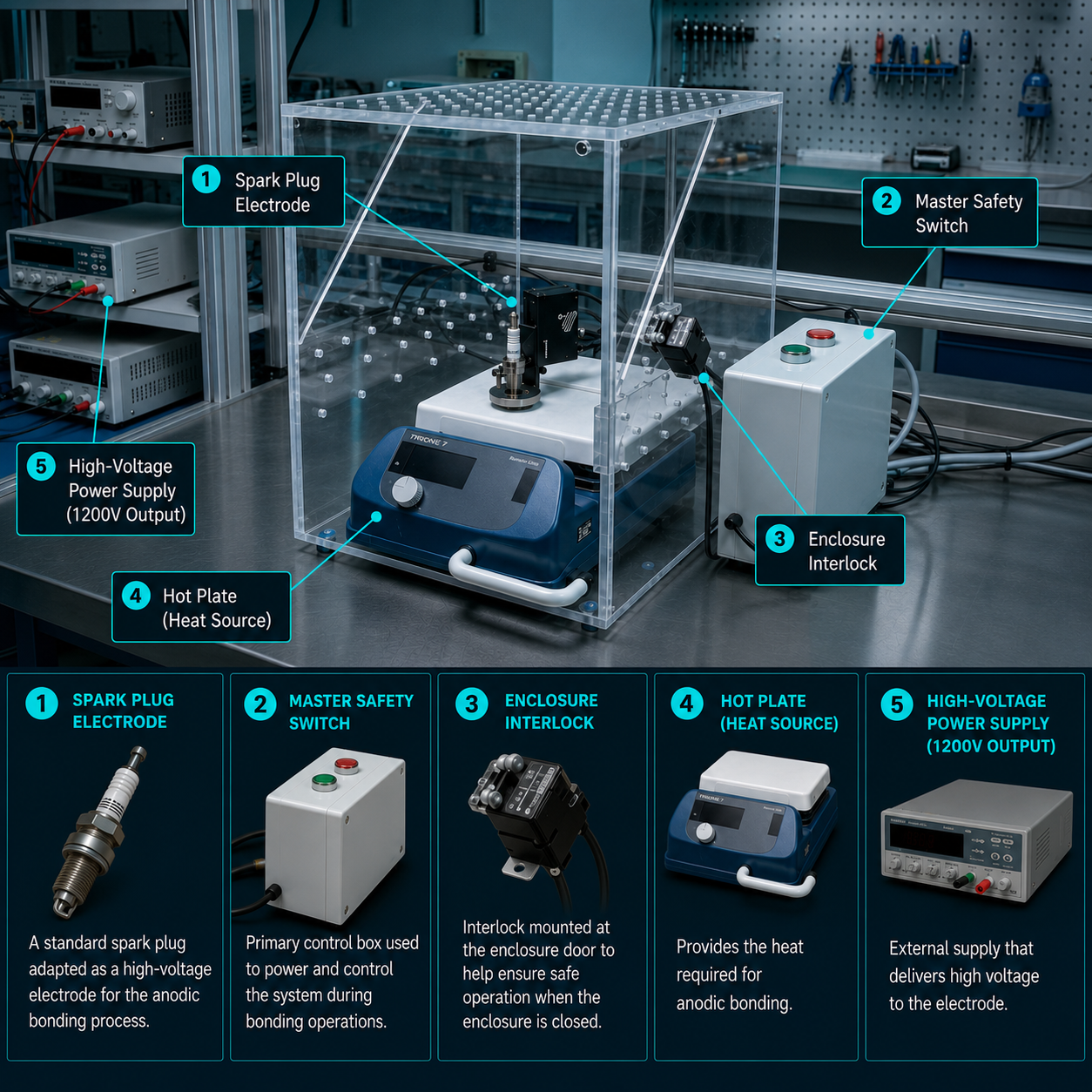
The enclosure was designed around the hot plate with an opening and closing mechanism, ventilation holes for heat dissipation, a safety latch, and a master switch to prevent operation while the enclosure was open.
Outcome
The result was a functional, low-cost research instrument that combined creative problem solving, rapid prototyping, off-the-shelf components, and safety-conscious engineering.
System Components
Annotated component overview showing how the low-cost anodic bonding station combines the enclosure, safety controls, heating source, and bonding hardware into one research tool.
System Design
An existing laboratory hot plate was repurposed as the heat source, then enclosed in a custom Plexiglass housing with a latch, master switch, and ventilation features to support safer anodic bonding experiments.